Chapter 1, Vietnam Veterans of America
 by Janelle Faignant
RUTLAND HISTORICAL SOCIETY
Quarterly • Volume 54 No. 2 2025
All photos: Vietnam Veterans of America, Chapter #1
It started here.
In the small city of Rutland, Vt., 45 years ago, the first chapter of a nationwide organization and movement was born.
On a recent, wintry late afternoon in February, a dozen members of Chapter 1, Vietnam Veterans of America, met at its home base at VFW Post 648 on Wales Street in Rutland. Secretary Jack Crowther quietly strummed a banjo as people trickled in. Membership Chair Dick Doyle took a seat up front; board members Tim Lonergan and Larry Gold attended in person, while President Bill Ellwood, Treasurer Richard Reed, and board members Mike Murphy and Carl Baldwin joined by Zoom. Two new members attended, as well as teenage cadets and a senior member from the Rutland Civil Air Patrol to ask for a donation for a trip to New York City they hoped to take. Ellwood was in the Civil Air Patrol before going into the Air Force and said, "These are future leaders, politicians, businessmen … a vital part of the community," and a unanimous vote approved the donation.
It was business as usual for Chapter 1, but it's a historic year for them. If we could rewind back to 1979, we'd see the meeting coming to order much differently, when the vets were still fresh from the war.
A Conflict Like No Other
The Vietnam War stands apart in American history, not only for its devastating impact but for the deep national divide it created. The United States became involved as early as 1950, when France was seeking to re-establish its power in Vietnam following World War II. By the 1960s, U.S. troops were fully engaged, with the goal of preventing the spread of communism in Southeast Asia. Following a clash between North Vietnamese torpedo boats and U.S. destroyers in 1964 — the Gulf of Tonkin incident — Congress gave President Lyndon Johnson authority to take necessary steps to "maintain peace," and a fast buildup of U.S. forces followed. The war ended with the collapse of the American-supported government of South Vietnam in 1975, after hundreds of thousands of fatalities, including more than 58,000 Americans.
Over 2 million Americans served in Vietnam, and it's the largest group of American veterans still alive. But when they came home, they were met not with gratitude but with hostility. Public sentiment had been shaped by media coverage, some showing children burned by napalm, and along with the war’s general unpopularity, many Americans directed their anger at returning soldiers rather than the policymakers who sent them into battle.
Many veterans returned home with post-traumatic stress disorder (PTSD), which was not understood at the time. Some employers were hesitant to hire veterans. In general, many vets were unwelcome and even made to feel ashamed in their own communities.
"People couldn't see you don't blame soldiers for what the politicians are doing," Ellwood said. "You look at our country right now, regardless of what your politics are, there's two distinct sides and they just want to attack each other. And this is what our country was like over Vietnam."
Every veteran experienced the war in a unique way. "I'm sure there's as many stories as there are people," said Murphy, who served in Vietnam in 1971.

"I was a draftee, I was a college graduate," Doyle said. "I spent a year in the jungle. In 1975 I joined the Army Reserves, and I stayed in until 2003."
"I wasn't an angry veteran, I just suppressed everything," Doyle said. "I took all my anger and anxiety and just worked hard and drank alcohol." But Chapter 1 was part of what helped him through it.
"That's a common story," Murphy said.
"I consider myself very lucky because of the different units I was in in Vietnam. Twenty-six of the people I served with were killed in action. So I have a lot of pain. But I deal with it," Doyle said. "It's been an interesting journey."
Mark Truhan, who served as Chapter 1’s third president from 1989 to 1991, called out the “wannabees" — those who only claimed a connection to Vietnam service after the perceptions of the war had shifted positively.
“Sen. Richard Blumenthal of Connecticut often claimed to have served in Vietnam," Truhan said. A New York Times investigation found that Blumenthal received at least five military deferments from 1965 to 1970, and records show he enlisted in the Marine Reserve, a move that "virtually guaranteed that he would not be sent to Vietnam," according to the Times.
Crowther served in Vietnam from the fall of 1965 to February 1966 as an assistant gunner on a 4.2 mortar platoon at Lai Khe. After Vietnam, Reed worked for years as a service officer helping vets receive benefits through the Department of Veterans Affairs. He and Crowther came home from Vietnam relatively unscathed.
"I am a draftee," Reed said. "You won't find many people who will say that from my generation. I was selected in the second draft lottery. My number was 32. I ended up enlisting in the Coast Guard, where I served from October 1971 to October 1975."
"In certain periods in our country's history the government has seen fit to trap the unwilling to do the undoable," Reed said, "and honestly I was involved in the anti-war movement. But. The options were limited."
"I ended up in north central Thailand on a LORAN station, which stands for long range aids to navigation," said Reed, who ran the radio there. "We were providing a signal in the southeast Asia chain, to primarily aircraft bombers going into North Vietnam, to tell them where they were. And it was extremely accurate."
In 2005 Reed was hired by the Vermont Office of Veterans Affairs as the state's first official service officer. "I covered the whole state," he said. "When I retired we had served several thousand veterans and recovered millions of dollars in benefits for Vermont veterans. Felt pretty good about that."
In 2019, Chapter 1 President Andy Megrath circulated a statistics sheet listing more than 1,500 American soldiers still missing in action from the Vietnam War. Another sheet listed a top priority of the Department of Veterans Affairs as suicide prevention, which still claims the lives of 20 veterans a day. "It's a problem and it's been a problem for a while," Reed said.
The Early Days
As the war and their service in it ended, veterans seeking to understand, preserve, and heal from their Vietnam experience had nowhere to turn. But in the late 1970s, determined to create a place of belonging, Marine veteran and Purple Heart recipient Don Bodette of Clarendon placed an ad in the local paper: "Vietnam veterans, we need to talk."
"We needed a place where we could get together because all of us were irritated with the fact that we were never really welcomed home," said Mark Truhan. "Unfortunately the United States was not a very welcoming country back when the Vietnam veterans were returning home."
A retired Army Reserve officer, Truhan received two Purple Hearts and three Bronze Stars with ”V,” for valor. Today he is one of the few remaining connections with Chapter 1’s early days.
"I bumped into Jake Jacobsen and Donny Bodette, who said we've got a couple of guys getting together. Come by and we'll talk about what's happening," Truhan recalled. "They were great guys. The earlier meetings we used to have at Don's house on North Shrewsbury Road (in North Clarendon), which is where I now live, only two houses down."
Informal gatherings took place at Bodette’s house, or in the old school bus on his property that was sometimes a mobile office. Bodette, alongside fellow veterans like Jake Jacobsen, Mike Dodge, and Truhan, pushed for official recognition of their fledgling group.

"We needed a big push from somebody, and that somebody was Bobby Muller in Washington D.C.," Truhan said. Muller came to Vermont and met Bodette in 1979. That year, Muller founded the Vietnam Veterans of America, and on April 13, 1980, the small group in North Clarendon had the distinction of becoming its first official chapter.
"There's no denying that these guys made it happen," Muller said during Chapter 1's 20th anniversary. And Truhan recalls the early days as "a simple start on a Vermont country road 50 years ago. It was really humble beginnings."
Jacobsen, who died in 2013, described their mission then as "looking for the wounded" — veterans who were made to feel ashamed about serving in the war, in addition to physical, mental, and emotional ailments. Aftereffects included various illnesses caused by Agent Orange, a highly toxic herbicide sprayed by the U.S. military to destroy vegetation. It was later found to cause a range of maladies, including cancer.
"It was before my time, but they were very angry, they were upset with the government, and they were upset with the VA, trying to fight for what they felt they should be getting, and it was a struggle for them," said Dick Doyle, who joined Chapter 1 in 1991 and has worked on membership recruitment since then.

Doyle drives 100 miles roundtrip to attend meetings and said, "I was a closet veteran for 20-something years. Joining Chapter 1 was the catalyst for me to come out as a veteran and meeting (these) guys; it's priceless to me."
"It was the kind of camaraderie that most Americans don't understand," Jacobsen said back then. "It was a welding of the soul," and he and Bodette felt that if the veterans could be bonded in war, they could be bonded in peace, at home.
Chapter 1 and the VVA began the ongoing battle at home for veterans’ rights, providing financial assistance, medical advocacy, and emergency support. Chapter 1 activities have over the years extended to the broader community that shunned them, with donations to local organizations and scholarships for students.
Early chapter records suggest that there were as many as 46 members whose goal was to meet with veterans in need of help. They once evacuated a man from his home by toboggan in an ice storm when he needed to get to the VA hospital for medication. There were successes, but Chapter 1 faced its share of struggles. By the early 1990s, membership dwindled, and the future of the organization was uncertain.

In 1991, when the Vietnam Veterans Moving Wall Memorial, a representation of The Wall in Washington, D.C., commemorating those who died in the Vietnam War, visited Rutland's Main Street Park, there were only a handful of members gathered under a tent. Mike Divoll, who had been a triage medic on the U.S.S. Constellation in the Gulf of Tonkin, met them while visiting the display and was inspired. He became president, a slate of officers was elected, and a structure was forged.
But stability was rocky. Back then Chapter 1 didn't have its office in the VFW. The group bounced around for years, which made it hard to keep stability and consistency. Doyle remembered meetings in coffee shops and VFW basements, and trying to recruit potential members whenever the opportunity came up.
By 1993, Doyle recalled, "A guy named Steve Faye was president, and he did a couple of years and got burned out. We were sitting at a meeting, at this time (we had) probably only 35 members, and people were going around the table saying, 'Well is this the end of us? Are we going to quit?'"

But then John Bergeron stepped in and became president — for nine years. "He was the glue that held us together in those tougher years when we were struggling to find our identity and to keep the chapter alive," Doyle said. "We'd meet in the back of his shoe repair shop for meetings."
"And then Andy Megrath became our president for 19 years," Doyle said. "So we had a lot of stability for many years."
By 1998 the chapter had increased membership by over a hundred, many of whom Doyle recruited from the internet and the VVA list server. But despite membership rising, there were still struggles. "In the mid ’90s we were poor as church mice," Doyle said.
Tomasi's
"It started off with a bang and sort of smoldered for a bit," Truhan said, "and then it took off again with some of the veterans that they have currently. They have moved it along. The amount of money that they've been able to garner through donations and dues is very exciting."
Things started to turn around after the late Jon Pintello, a longtime treasurer of Chapter 1 who died in 2024 of cancer attributed to Agent Orange exposure, arranged break-open ticket sales at Tomasi’s Tavern in Fair Haven, to help raise money for Chapter 1. For years now, current treasurer Richard Reed has worked closely with
Shaun and Danielle Tomasi, associate VVA members who own Tomasi’s.
"That's been our absolute saving grace in terms of financial stability over the past 10, 12, 15 years," Doyle said.
"Their support has been crucial and key to our ability to have a healthy balance in our treasury and make grants to deserving individuals and organizations," Crowther said.

We've done very well over the last 10 years in terms of finances, and it gives us the opportunity to return a lot to the community," Reed said.
Chapter 1 has been like a giving tree donating to many organizations, like No One Left Behind, which assists Afghans who helped the U.S. military during that war and Save the Children, which provides aid to children in the world's troubled spots. Local non-profits like the Community Cupboard, Evergreen Cemetery, the Boys and Girls Club of Rutland County, Rutland’s Open Door Mission, Vermont Adaptive Ski & Sports, and the Vermont Farmers Food Center have benefitted.
The chapter has also established a scholarship for graduates of the Stafford Technical Center and funded a trust fund with the City of Rutland for maintenance of the Rutland County Vietnam Veterans Memorial. (The public can contribute to the memorial trust fund as well.)

"We've helped some individual veterans who just don't have any resources and had issues with heat, or repairs, or dental work, which is what we should be doing with our money," Murphy said.
When a vet lost his home and finally got into affordable housing, Chapter 1’s associate members organized a starter kit of household supplies to help. In 2015 two high school students asked for a donation to their student exchange program travels. Later, one of the students wrote Chapter 1 a letter of thanks, saying, "This exchange has been one of the most positive things in my life and I am so incredibly thankful that you all are a part of it."
One veteran who had been in the battle of Khe Sanh had been shot in the jaw, neck and back during the war. Amazingly, he survived. He spent over a year in hospitals afterwards, lost almost all of his teeth, and has needed dental help all his life. But he was being denied care and a Chapter 1 member stepped in to help.
"It brings you to tears," Murphy said, "but you have to hear this kind of story just from the standpoint of some of the veterans.”
Ongoing assistance has gone to the Dodge House, Vermont's only facility devoted to homeless veterans, located in Rutland. The Dodge House is a project of the Veterans Assistance Office, which Don Bodette and Chapter 1 helped establish in Rutland. The late Clark Howland, one of the earliest members of Chapter 1 and of VVA, was the director of the VAO, which was located in the Dodge House. The home was named for Mike Dodge, an original member of Chapter 1 who tragically committed suicide in a VA hospital in 1987. "We loved him, and it demolished us when he committed suicide," Howland said then.
In the spring of 2016 the Council on Aging asked for and received a donation to help clean up the property of a
Vietnam veteran who had suffered a stroke and was unable to take care of it himself and facing eviction.
In fact in almost every meeting, if not all, someone from the community seeks Chapter 1's assistance, rarely turned down.
"We're not really a philanthropic organization, but we have the funds to be able to help people," said Ellwood. "It used to focus on veterans, but it doesn't have to be just veterans. We're a group of veterans that want to help our community."
Rutland County Vietnam Veterans Memorial
Chapter 1's most visible achievement is the Rutland County Vietnam Veterans Memorial in Rutland's Main Street Park. It bears the names of 18 Rutland County soldiers who never returned home, and stands as a testament to the sacrifices made.
The memorial started with John Reno, who had a dream to carve a monument for Vietnam veterans. He had struggled with depression and recurring flashbacks after his Vietnam service, and in 1981 started working on the sculpture as an outlet for his anger and pain. He died suddenly in 1982, and the three-ton piece of marble he was working on was left neglected.


Chapter President John Bergeron later picked up the torch. He tracked down Reno’s marble block and had it brought to West Rutland, where sculptor Don Ramey finished the project. After extensive fundraising and volunteer participation, the memorial and its marble centerpiece was dedicated on Memorial Day 2000. Ramey subsequently carved a replacement for the original sculpture, which had suffered weathering and deterioration over the years.
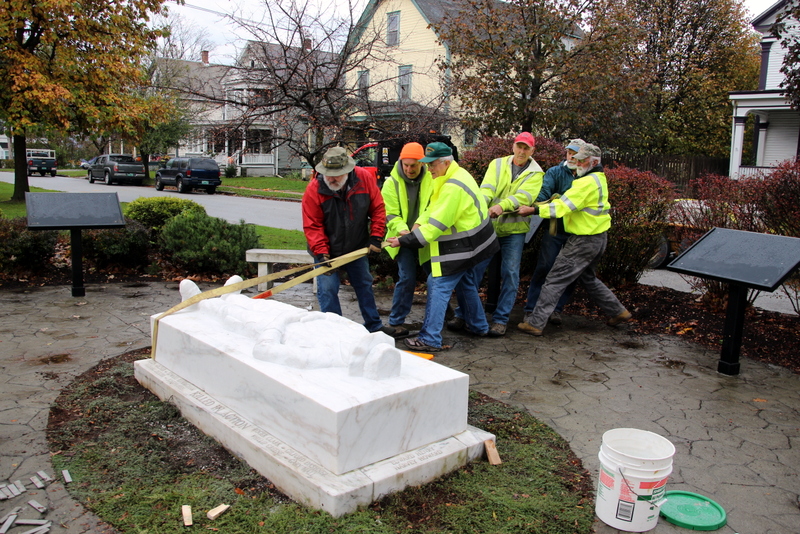

"That kind of gave us new life," Doyle said. "The memorial got people interested."


The memorial also pays tribute to Bodette, who died of cancer in 1997, and lists an Honor Roll — service members from Rutland County directly involved in the Vietnam War. Only 125 people were on the original list, but it continues to evolve as more veterans are located or step forward. Publicity for Chapter 1's 25th Anniversary helped attract 26 new names to the Honor Roll. By November of 2024 it had grown to 357 people.

"I've got two more to go on next year," said Ellwood, who recalled after his retirement in 2012 that a friend asked if he had been to Rutland's Vietnam memorial. "He said, 'You need to go, your name's on the Honor Roll.'" That opened the door to Chapter 1 for him.
"Prior to that I really didn't have much to do with being a veteran," Ellwood said, and that was the story for many veterans. They didn't know about Chapter 1 or weren't interested in joining for a variety of reasons. But that is turning around.
Membership and Building a Lasting Impact
As Vietnam veterans have gotten older, sustaining membership, the lifeblood of the organization, has been difficult. Many chapters have closed across the country, leaving members without a chapter to call their own.
"Many of the chapters I've been with in the past have closed up," Reed said. "It's hard; we're all dying off. So that's why Chapter 1 is going with 'First In, Last Out.' We're going to stick around; we'll turn out the lights."
Doyle and Murphy have been working to recruit veterans who weren't aware of Chapter 1, and to round up members whose chapters have closed. They have tracked down over 100 VVA members so far.
Doyle recalled that in the mid ’90s a half dozen Chapter 1 vets would march in parades on weekends in the summer with a color guard all over the state. "And then that kind of petered out," he said. With the chapter's visibility in the community fading some, so did membership.
Periodically for years, as little as three to five members would show up to meetings, which made it hard to accomplish their goals. But when COVID hit, despite lockdown, attendance actually grew because people could join through Zoom, including Murphy, who lives in Virginia.
"That was good," Murphy said. "I got to see people and know people, I started participating more. Zoom has helped attendance at our meetings greatly."
More members who are active in the chapter means more help can get to those who need it. One goal was to go to local senior living communities, anywhere there might be a veteran, in particular if they are isolated. "That takes a lot of people on the ground and we're struggling to make that happen but that's the goal," Murphy said. "We should be visiting them in hospitals and offering support, and I can tell you, veterans open up more to other veterans than anyone else."
"We believe in the military theme, 'No one left behind,’" Murphy said. "There are guys around who are just hibernating. A lot of the stuff you hear, PTSD, it's real."
"One of them when he got home people just crapped on him," Murphy said. "He still talks about that; he's bitter."
"The goal is to get people on the ground, and hopefully find some guys hiding out," Murphy said, " I'm not saying every veteran is in need, but there's a bond that exists for those of us still here."
There are almost 90,000 members of the Vietnam Veterans of America, and at one time there were thousands of chapters in the country. Several chapters in Vermont have shut down in the last year and there are only three left, in St. Albans, Bennington, and Rutland. And that's been the trend nationwide.
"The national headquarters is in the mode of shutting down in a couple years, and that's not us. We want to stay," Murphy said. "But we have to get membership up. We would then seek a charter with the state, but even that's iffy." It's taken a lot of legwork for Doyle and Murphy because many vets don't have email or current phone numbers listed, but new members are starting to trickle in. They recently had five transfers — the result of 107 emails sent.
"We're sputtering, but trying to get ourselves to the point where we can be proactive for the community, and that takes members who will show up and act," Murphy said.
As membership chair, Doyle has been managing membership since 1993, when there were just 28 members. He and Murphy have a goal to place “orphaned” VVA members with the remaining chapters. "It's paying dividends," Murphy said. "Very slowly but it is. We're trying to get the word out, trying to build up the club again. It's been a lot of work."
Chapter 1 picked up about 10 new members in the last month, and at the mid-March meeting this year membership was approaching 150, an all-time high.
"We have members from all over," Doyle said. "I think part of our success is the newsletters that go out after every meeting."
“Jack Crowther does an excellent job creating a very professional newsletter that goes out to all members, keeping them up to date on chapter business and activities," Ellwood said.
Records of the chapter date back to pre-computer days, with earlier meeting notes handwritten and now saved digitally. "The newsletters are also digitally archived and stored online through the Rutland Historical Society as part of our preserved history,” Ellwood said.
Later Years
Part of the struggle in staying afloat is fluctuating attendance at meetings. One meeting in 2016 had only two members attend. Yet the chapter has persevered. It celebrated its 25th anniversary in 2005, with a banquet attended by Vermont Gov. James Douglas and his wife Dorothy, VVA National President Tom Corey, and about 90 others. The chapter had 137 members at the time and a healthy balance in the treasury.
But as the veterans get older and the national VVA considers disbanding in the coming years, Chapter 1 is exploring ways to continue its mission to support veterans and serve the community. Chapter 1 hopes to send delegates to the national VVA Convention this August in New Orleans, because as the organization contemplates its eventual dissolution, this will be an important gathering.
"A lot of it is trying to motivate people," Ellwood said. "Over the years you lose people and everybody's getting older. A lot of people are members but not participating. Doesn't mean they're not interested, but what I took on is to try to get people involved. I think we can do a lot of good in the community. That's part of the reason I want to continue with it and keep things going."
In prior years Chapter 1 was more visible in the community, for example marching in parades, but mobility issues as members get older make it harder now. But Chapter 1 is working on bringing some of that visibility back.
"I wear my veteran hat because I'm looking for other veterans I can talk to," Ellwood said.
A great means to more visibility is at the Veterans Town Hall that takes place once a year in Rutland at the Godnick Center and in other Vermont towns. Veterans are invited to talk about their experiences with other veterans and the general public at a public forum. "It's good for the veteran, because some of them have never been able to talk about their experiences before, and other veterans can relate to it, and it's good for the public to hear stories that they might not hear," Ellwood said.
"There's a lot of people that might not even know there's a Vietnam Veterans of America organization," Ellwood said. "A lot of people never heard of it, and a lot of the veterans out there don't realize they can join. (They) think you had to serve in Vietnam. No, you just had to serve in the military from 1964 to 1975 and have anything except a dishonorable discharge."
"It's part of the reason I wear the hat. We've encouraged people: If you served let us know; get us your DD-214 (military service record).”
A Legacy of Brotherhood and Service
"When we started, people didn't particularly like the Vietnam veterans and part of the reason they started their own organization is because the other veteran organizations really didn't want them. The VFWs, American Legions, they basically thought we lost the war.
But that has all changed, all those organizations welcome any of the veterans," Ellwood said.
"Being secretary of Chapter 1 since 1997 (except one year) has helped me understand what I was part of — this disastrous chapter of U.S. and Vietnam history," Crowther said. "My own time in Vietnam was short and largely free of danger. Associating with fellow vets and learning about their experiences has informed me in ways that my formal reading about and experience of the war couldn’t."
"They don't teach that in school," Reed said, and Ellwood said, "I would like to have more people to go into the schools, if there's an interest."

At one point a group from Middlebury College studying the Vietnam War visited Chapter 1. A dozen vets were there to tell them about their experiences and give them some real-life information, not just learning about it from what's been written in books.
Other future goals include updating their website, with news on upcoming events like the Veterans Town Hall and parades; helping the Dodge House and the Open Door Mission more; as well as the future preservation of the Main Street Park memorial.
"There's a lot of potential," Ellwood said, "it's getting people to meetings and finding out what's going on. These are the type of things that help build up a strong community."
Longtime member Andy Megrath, who served as president from 2004 to 2023, recently decided to step down from his current post as vice president. In 2018, Chapter 1 recognized his extraordinary service, presenting him with a marble carving of the center sculpture at the Rutland County Vietnam Veterans Memorial. The Chapter 1 banquet in 2023 was dedicated to him.
Megrath’s work on behalf of all veterans has included service on the State Council of the VVA and the Governor’s Veterans Advisory Council. He oversaw many Chapter 1 events, including its 25th Anniversary celebration in 2005. He generously gave his time to schoolchildren and others interested in first-hand information on the Vietnam War. He coordinated installation of the new marble sculpture at the Vietnam memorial in Rutland in 2017, replaced flags as needed, and even cooked burgers at an annual Vermont Veterans’ Home picnic in Bennington. The Vietnam Veterans license plate was another initiative Megrath helped achieve.
Ellwood noted that when the veterans in the organization are gone there will no longer be someone you can go to in person to ask about these events, this period in time. To that end he and Crowther have spent a lot of time scanning meeting minutes and relevant documents, and identifying people in photos to archive with the Rutland Historical Society. "Eventually if something happens to the organization, we've recorded that history," Ellwood said.
Chapter 1's efforts to preserve historical records, ensure future care for the memorial, and expand outreach to isolated veterans continues, keeping the spirit of "First In, Last Out" alive.
And what began under a nationwide umbrella of negativity toward the Vietnam War and its veterans has blossomed into a beacon of positivity on a national scale.
The Obama administration began reviewing veterans deserving of the Medal of Honor (the nation’s highest military honor) who were previously overlooked, and it led to a Chapter 1 connection. In early 2025 Doyle went to the White House to see a Vietnam buddy receive the Medal of Honor. "That was surreal," Doyle said. "One of the most heartwarming events of my entire life. He waited 54 years."
"My own view is that the bitterness and controversy over an unpopular war have faded," Crowther said. "Also a factor is that as we age and need more health care, the experience of fellow veterans in dealing with the system and the moral support can be helpful."
"I feel proud to have persevered, and right now we're in a really good place," Doyle said. "Except we're getting older. Four chapters in Vermont are gone now and that's happening around the country."
"The fact that it's the number one chapter — so many people don't realize that," Murphy said. "The first chapter from the entire Vietnam War was formed by some guys here (and a few women) who saw the need."
"Way back in the beginning people didn't even want to hear about Vietnam veterans," Ellwood said. "All that has changed. We're in a different world and I think a lot of it changed with September 11. They realized how important the military is and began to appreciate the people willing to serve their country."
"In the last 20 years things have turned around," Ellwood said. "We've been through (a lot) but things are much better."
"It is the best organized that it has been since its inception back in 1980," Truhan said. "Even the passion is there."
"We're able to do a lot of nice things for the community and for our veterans," Doyle said. "We don't come to a meeting and say, 'Okay, what's next?' We always seem to have a what's next, and that's good for us."
Anyone interested in helping the Vietnam Veterans of America can join, as a regular or associate member. "To me, that's going to be where our legacy gets carried on," Ellwood said of the associate members. "Just like the Sons and Daughters of the American Revolution: Those guys are long gone but that organization carries on for them."
But that day is still a ways away, and with Chapter 1 membership at an all-time high as of their last meeting, Reed said, "As a veterans organization there's a great deal we can do right now, and we want to do it while we can."
If you served on active duty in the military for other than training purposes at any time from Aug. 5, 1964 to May 7, 1975, you are eligible to join Vietnam Veterans of America!
To learn more about Chapter 1, visit www.vietnamvetschapter1.org
To learn more about the Vietnam Veterans of America, visit www.vva.org
To learn more about Associates of Vietnam Veterans of America, visit www.avva.org
 _______________
About our Author: Janelle Faignant
Janelle Faignant grew up in Rutland. She has a degree in English from Penn State University. She previously worked for the Los Angeles Times, and has written for Creative Loafing, Rutland Magazine, and for the Rutland Herald for more than 10 years. You can reach her at writteninrutland@gmail.com.